
Fairbanks businesses pay some of the highest energy costs in the country. The Carlson Center alone carries a $547,620 annual utility bill. Borough schools and facilities spent a combined $8.87 million on heat and power over the past year. A commercial building in Fairbanks can easily run $2,000 electric and $3,700 gas in a single winter month. For commercial property owners across the Interior, heating is one of the largest operating expenses, and for many, it determines whether the building stays open through winter at all.
Winterizing a commercial building in Fairbanks is expensive. Upgrading insulation, replacing windows, hardening HVAC systems for sustained extreme cold. These are six-figure projects. For a business already operating on thin margins in a short season, the math doesn't work. Some close for winter instead. Others defer the improvements indefinitely and absorb the heating bills.
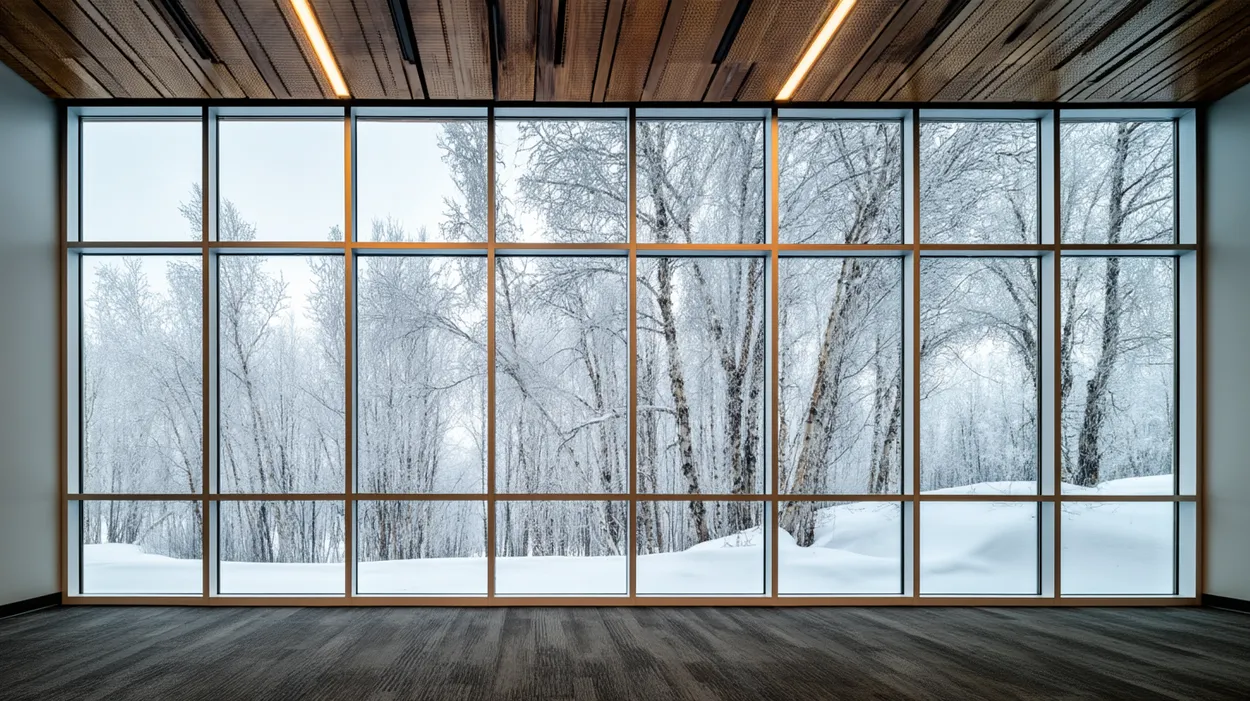
What a wall of glass can do at -40°F
We've been testing vacuum insulated glass on-site through this winter. It insulates essentially like a wall.
In a conventional building, windows are the weakest point in the thermal envelope. In Fairbanks, that weakness is compounded by sustained extreme cold, ice fog, and temperature differentials that stress seals and frames beyond what temperate-climate products are designed for. Most commercial buildings in Fairbanks are glazed with quarter-inch single-pane safety glass or one-inch double-pane clear safety, often with bronze or green tint and occasionally a single low-e coating. These units fail here in ways they don't fail in Seattle or Denver.
Vacuum insulated glass eliminates the gas fill between panes entirely. The vacuum gap virtually eliminates conductive and convective heat transfer. What you get is a window that approaches the thermal performance of an insulated wall while still letting light through. In a climate where buildings receive 3.7 hours of daylight at solstice, that matters.
Modern building envelope assemblies (vacuum insulated glass, continuous insulation, thermal breaks, advanced vapor barriers) can cut heating energy in half compared to construction from the Carlson Center era. When heating is one of your largest line items, the building envelope is where the money goes.
Manufacturer specifications from temperate climates do not predict performance at -40°F. Fairbanks is one of the best places in the world for materials testing because the climate is this demanding.
The problem is financing
A building owner who knows the improvement will pay for itself still can't write the check upfront. The improvement pays for itself over time, but the capital requirement prevents it from happening.
Fairbanks has the highest energy costs on the Railbelt, a federal PM2.5 nonattainment designation driven partly by heating fuel combustion, aging commercial building stock, and a declining population. The improvements that would help are the same ones building owners can't afford upfront.
This is a solved problem in 40 states plus Washington, D.C.
C-PACER
Commercial Property Assessed Clean Energy and Resilience (C-PACER) allows commercial property owners to finance energy efficiency, renewable energy, and building resilience improvements through a voluntary special assessment on their property tax bill.
How it works:
- A commercial property owner identifies an eligible improvement: HVAC, building envelope, insulation, lighting, renewable energy, seismic hardening, snow-load management, backup power
- A private capital provider finances the project. Not the borough
- The property owner repays over 15-30 years through their tax bill
- If the property is sold, the assessment transfers to the new owner
- Written mortgage lender consent is required before any assessment is placed
The borough's role is adding the assessment line to existing property tax bills, a function it already performs for other special assessments. It can also contract with a third-party administrator at no cost.
C-PACER creates no municipal debt, no taxpayer exposure, and no general fund risk. Local governments typically charge a 0.5-1% administrative fee on each assessment, which covers the cost of running the program and then some.
Alaska already authorizes this
The Legislature passed HB 80 in 2017 (signed by Governor Walker), creating the legal framework under AS 29.55.100-.165. In 2022, the Legislature expanded the program through HB 227 (signed by Governor Dunleavy), adding resiliency improvements and new construction as eligible categories.
Anchorage adopted C-PACER on November 4, 2020. The Mat-Su Borough followed in September 2022. The first major project in Alaska was the Wildbirch Hotel, a renovation of a 1970s-era Holiday Inn now operating as a JdV by Hyatt property. It used $16.8 million in C-PACER financing for energy efficiency and resilience improvements.
Nationally, C-PACER has financed $9.8 billion across 2,440 projects, including $2.57 billion in 2024 alone. The program's structural features contribute to historically low default rates: senior lien priority, non-acceleration of the obligation, and attachment to the property rather than the borrower. C-PACER enabling legislation has been signed by 13 Republican governors and 18 Democratic governors.
Cold-climate states with active programs include Connecticut ($200M+, 340 projects), Montana (24 counties), Maine, Minnesota, and Colorado.
Where FNSB stands
The borough passed Ordinance 2025-32 in January 2026 expressing interest in establishing a C-PACER program. The next step is an administrative resolution defining the collection and remittance process. The Alaska Energy Authority provides template ordinances, program documents, and a handbook. Alaska Sustainable Energy Corporation has offered to assist where they can to get FNSB's program established.
What about residential?
C-PACER is a commercial program. Residential PACE programs in other states have a predatory lending problem: high-pressure sales, inadequate disclosure, assessments placed on homes where the owner didn't fully understand the terms. Alaska law authorizes only the commercial program.
Financing aside, the glass technology applies to homes too.
Most homes in Fairbanks have double-pane windows with a single low-e coating, or triple-pane with double low-e. These are better than what's in the commercial stock, but a single-pane window (R-1) still loses roughly 10 to 20 times as much heat as an insulated wall (R-21), and the gap widens further against Arctic-grade assemblies. Full window replacement is expensive and disruptive. Most homeowners put up plastic sheeting, add storm windows, or live with the drafts.
Vacuum insulated glass is thin enough to fit existing window frames. Swap the glass, keep the frame. No full window replacement. A double-pane low-e window becomes a window that insulates like a wall, in the same opening.
We are testing vacuum insulated glass on our site because our project requires it, but the results are relevant to anyone in the Interior heating a building with old windows, which is a lot of people.
Why C-PACER matters beyond one project
We are using energy efficient systems on the North Star Grand Lodge because the economics of operating a resort at 64° north demand it. Without C-PACER, we would finance these improvements at higher cost and higher risk to our project. We have that option, but many commercial property owners in Fairbanks do not.
C-PACER addresses energy costs, air quality, aging buildings, and population decline. It costs the borough nothing and is already adopted in Anchorage and Mat-Su.
What would lower energy costs mean for your business or building? What questions do you have about C-PACER? We want to hear from you.
Email: dan@northstargrandlodge.com
Daniel Keck
DX/DT LLC
Fairbanks, Alaska
What do you think? Join the conversation on our Facebook page.