
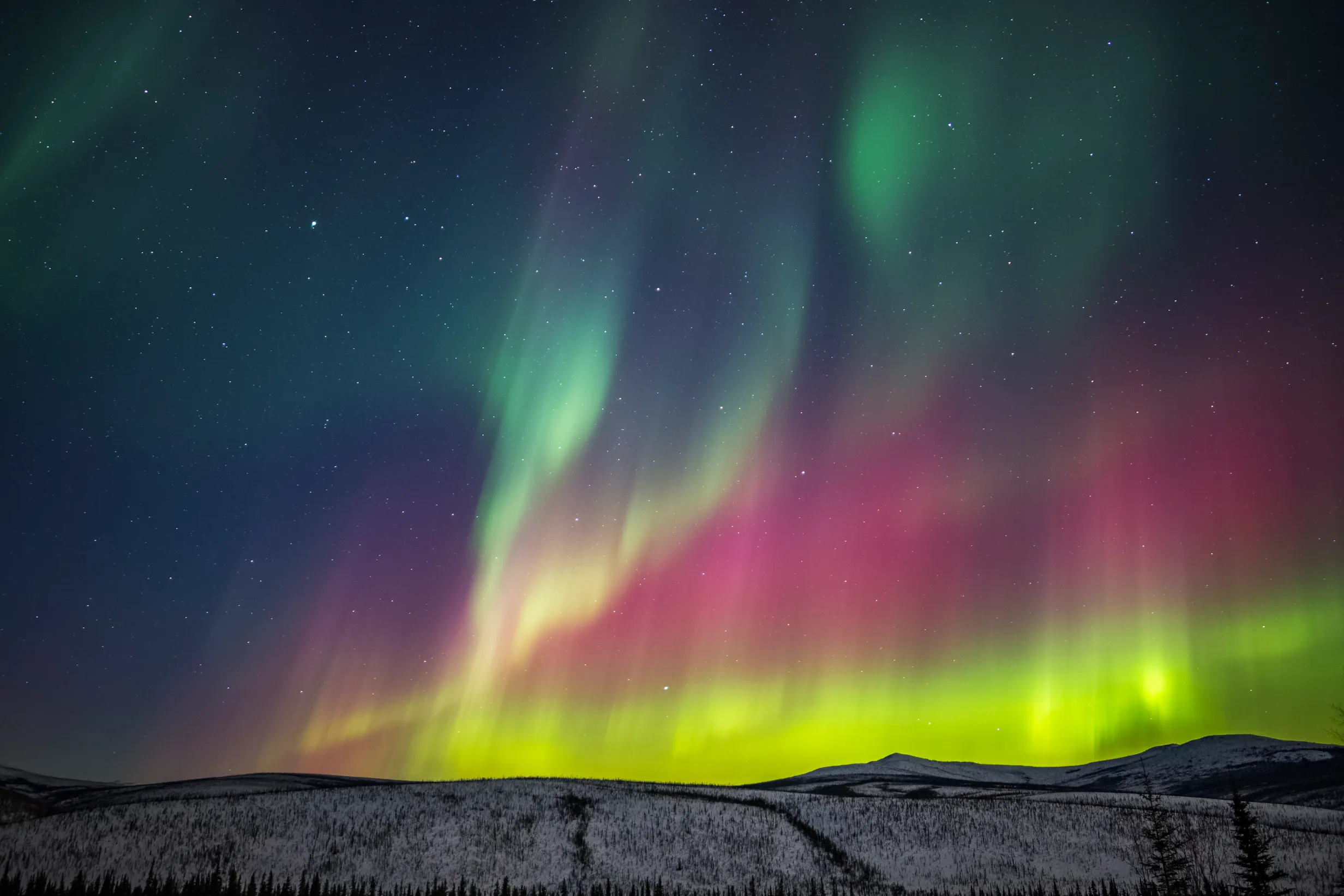
Fairbanks sits under one of the darkest, longest, and most scientifically active skies accessible from any city in North America.
At winter solstice, the sun is up for three hours and forty-one minutes. That leaves over twenty hours of darkness on the longest night, and from late October through mid-February, the sun never climbs far above the horizon. Drive twenty minutes outside of town and you're under Bortle Class 1 skies, the darkest designation instruments can measure. The aurora is visible four out of five clear nights from August through April. Poker Flat Research Range, thirty miles northeast of Fairbanks, is the only university-owned rocket range in the world, launching sounding rockets into the aurora since 1969 with more than 1,700 launches over more than fifty years. The UAF Geophysical Institute was founded by act of Congress in 1946 to study the aurora borealis and operates the premier aurora forecasting service in North America.
This is one of the most important places on Earth for studying what happens between the ground and the edge of space. What it does not have is a public observatory.
The only public observatory in Alaska is Stargate Observatory in Wasilla, 360 miles south. It houses a 26-inch reflector and a 10-inch Schmidt-Cassegrain at the Mat-Su Career & Technical High School. It opens on occasional Friday and Saturday evenings, weather-dependent.
Fairbanks used to have telescope infrastructure. The Sydney Chapman Building on the UAF campus was built in 1950 with an astrodome and a 12-inch reflecting telescope in its penthouse. In 1994, UAF donated the telescope and dome to the Fairbanks Astronomical Unit, the local amateur club. The penthouse is now storage. The Geophysical Institute operated an auroral observatory on Ester Dome with all-sky photometers and a Fabry-Perot interferometer. It was demolished. HIPAS Observatory, a UCLA ionospheric research station 25 miles east of Fairbanks with a 2.7-meter liquid mirror telescope, operated from 1986 until its director retired and funding dried up. The equipment was auctioned in 2010.
None of these were public facilities. The pattern is that Fairbanks had research telescope infrastructure, and it was given away, demolished, or defunded. The public was never the audience.
Today, people who want to observe go to Creamer's Field because it is a wide-open area with a low horizon, not because it has any astronomical infrastructure. UAF occasionally sets up telescopes on West Ridge near the Butrovich Building when a comet or event warrants it. These are ad hoc sessions, weather-dependent, unadvertised to visitors, and over when the event passes.
That is starting to change. The $9.5 million Walt & Marita Babula Planetarium at the UAF Museum of the North opens this month: a 65-seat, 36-foot tilted dome with 4K fulldome projection, built as a joint project between the museum and the Geophysical Institute. It is the first permanent planetarium in Interior Alaska, funded largely by a $7.4 million gift from Fairbanks orthodontist Walt Babula and his wife Marita. The Geophysical Institute also runs a Planet Walk scale model of the solar system on campus, a weekly Alaska Science Forum column, and a public lecture series.
The Babula Planetarium shows the sky on a dome. Fairbanks still has no facility that shows the sky through a telescope.
Most of what people think of as "astronomy" happens at lower latitudes. The major observatories are in Hawaii, Chile, the Canary Islands, places where the atmosphere is thin, dry, and the Milky Way core passes overhead. Fairbanks is not competing with Mauna Kea; it offers a fundamentally different sky.
At 64 degrees north, everything within 64 degrees of Polaris is circumpolar: it never sets. Ursa Major, Cassiopeia, Cepheus, Draco, Camelopardalis, and much of Perseus and Auriga are above the horizon year-round. The Big Dipper doesn't rise and set here. It circles the pole all night, every night. For a visitor from the lower 48, the sky looks wrong, and that is why they come.
Winter is deep-sky season. Cold, dry interior air produces atmospheric transparency that mid-latitude observers rarely experience. The Orion Nebula, the Pleiades, and the Andromeda Galaxy are naked-eye objects under these conditions. On a clear January night, a dark-adapted eye can see stars past sixth magnitude. The winter Milky Way arcs across the sky in full structure. For deep-sky observers, the long darkness is the asset: a single winter night provides ten to twelve continuous hours of observing, more than double what most lower-latitude sites can offer.
Summer replaces darkness with a different phenomenon. From late May through early August, Fairbanks has extended twilight where the sun stays 6 to 16 degrees below the horizon for hours. That geometry illuminates noctilucent clouds: thin sheets of ice crystals at 50 miles altitude in the mesosphere, the highest clouds in Earth's atmosphere, visible only between roughly 50 and 70 degrees latitude when the observer is in shadow but the mesosphere is still sunlit. Guests from the lower 48 have almost certainly never seen them. Guests from Fairbanks have been watching them their entire lives without knowing what they were. Noctilucent clouds have been increasing in frequency as atmospheric methane concentrations rise, making them one of the few astronomical phenomena that are becoming more visible, not less.
And then there is the aurora. The solar wind hits Earth's magnetic field and the collision is visible, in real time, 60 to 200 miles overhead. Fairbanks sits inside the auroral oval, the ring of maximum geomagnetic activity encircling Earth's magnetic pole. The aurora is not occasional here. It is structural.
Between the aurora, the winter deep sky, and noctilucent clouds, there is something worth pointing a telescope at in every month of the year.
North Star Grand Lodge is building a dedicated Astronomy Park on the resort campus: the first public observatory in Interior Alaska.
The observation platform is wind-screened with heated pavers, vibration-isolated telescope piers that tie into the primary building frame (not the deck), and motorized weatherproof covers that open in minutes when conditions break. An adjacent indoor astronomy lounge serves as classroom, staging area, and bad-weather fallback with red-safe lighting throughout.
The core instrument is a 20-inch corrected Dall-Kirkham reflector on a research-grade automated mount. This is a serious telescope. At 20 inches of aperture under Bortle 1 conditions, it resolves spiral arm structure in galaxies, individual stars in globular clusters, and color in planetary nebulae that a smaller instrument shows only as gray. Two 150mm apochromatic refractors provide wide-field views for visual observing and guided astrophotography. A dedicated hydrogen-alpha solar telescope opens daytime programming: sunspots, prominences, and solar flares, visible in real time.
An on-site 4K digital planetarium, accessible from the lounge, guarantees a program even when weather does not cooperate. Full-dome shows, live sky tours, and "what the clouds are hiding" sessions give guests a complete experience regardless of conditions. The Babula Planetarium at UAF serves the campus and community. The Astronomy Park planetarium serves resort guests and integrates directly with the observing program, so a guided session can move from the dome to the eyepiece without a fifteen-minute drive.
Year-round programming:
Winter (October through February). Peak deep-sky season. Guided star tours, astrophotography sessions on the 20-inch, and aurora integration. On active aurora nights, the program shifts from deep sky to aurora in real time. The transition itself, watching the sky transform from stars to light, is part of the experience.
Spring and fall (March, April, August, September). Aurora shoulder season. The sky darkens enough for deep-sky observing by late evening while aurora activity remains strong. Solar viewing during the day. Citizen science campaigns timed to equinox sky quality measurements.
Summer (May through July). Noctilucent cloud watches during extended twilight. Solar observing with the hydrogen-alpha scope. Midnight sun astronomy: the sun doesn't set, but it can still be studied. Planetarium programming fills the gap for guests who came for the aurora and found daylight.
The birding initiative commits to eBird contributions. The dark sky initiative commits to Globe at Night. The Astronomy Park extends both models.
Globe at Night is an NSF-supported program where participants compare the night sky to reference charts and submit naked-eye limiting magnitude estimates. A 2023 study in Science used Globe at Night data to document rapid reductions in star visibility worldwide from 2011 to 2022. Contributions from Fairbanks add data points from one of the few accessible Bortle 1 corridors in North America.
AAVSO (American Association of Variable Star Observers) maintains a database of over 54 million observations from more than 2,000 observers across 52 countries. Variable star observations from a 20-inch telescope under dark skies contribute real data to a 115-year-old scientific program.
Aurorasaurus is a citizen science project that collects aurora reports from observers worldwide to improve auroral models. Fairbanks sits in the most active zone. Guest observations submitted from the Astronomy Park contribute to a global real-time aurora mapping effort.
Zooniverse, the world's largest citizen science platform, offers projects that require no equipment at all: Galaxy Zoo, Planet Hunters TESS, Kilonova Seekers. Planetarium bad-weather sessions become citizen science sessions, with guests classifying galaxies or searching for exoplanets on-screen while the clouds clear.
These programs produce real data. Over 650 NASA citizen scientists have co-authored published papers, and observations submitted from the Astronomy Park would feed directly into those databases.
Poker Flat Research Range launches rockets into the aurora every winter. The missions carry names like BADASS (Black and Diffuse Aurora Science Surveyor) and GIRAFF (Ground Imaging to Rocket investigation of Auroral Fast Features). They have reached apogees of 930 miles. The range is thirty miles from the NSGL site.
The Geophysical Institute operates the College International Geophysical Observatory, a network of instruments on the UAF campus collecting geomagnetic, seismic, and geophysical data. It operates nineteen facilities and laboratories and more than 500 permanent field sites across Alaska.
This is not a place that has to import scientific credibility. The credibility is already here, and it is growing. The Babula Planetarium, Poker Flat, the Geophysical Institute, and an active research community are building an ecosystem. The missing piece is a public observatory. The Astronomy Park is designed to be that: a facility where visiting researchers can give public talks, where sounding rocket launches can be live-streamed to guests, and where the science being done thirty miles away becomes visible to the people visiting sixty-four degrees north to see the sky.
A 2025 survey of 27,000 travelers by Booking.com found that 62% plan to visit dark sky destinations. Stargazing was the number one travel trend prediction for 2025. 59% wanted access to star guides.
The global astrotourism market was valued at $1.18 billion in 2025, projected to reach $3.47 billion by 2034, growing at 12.7% annually. North America accounts for 35% of global spend.
A peer-reviewed study of the Colorado Plateau projected $5.8 billion in dark sky tourism spending over ten years, generating $2.4 billion in wages and over 10,000 jobs annually. A 2022 NPS survey found that 62% of Utah's state and national park visitors participated in night sky recreation.
DarkSky International has certified 250 dark sky places across six continents. Lowell Observatory in Flagstaff, the closest domestic parallel, draws over 100,000 visitors per year, just completed a $53 million expansion, and was named one of TIME's 100 World's Greatest Places in 2025.
83% of the global population lives under light-polluted skies. The places where you can actually see the sky are disappearing. The number of people willing to travel to reach them is not.
Flagstaff's economy runs partly on a decision Percival Lowell made in 1894 to build a telescope where the sky was dark. That telescope led to a lighting ordinance in 1958, a community identity built around darkness, and eventually to a $53 million expansion that draws over 100,000 visitors per year. The sky was always the asset. The observatory made it usable.
Fairbanks has the same institutional foundation. The Geophysical Institute, Poker Flat, the auroral oval, the darkest accessible skies on the continent. The Babula Planetarium just added immersive education to the picture. What Fairbanks does not have yet is a place where anyone can look through a telescope at a real sky.
That is what the Astronomy Park is. A real observatory with real instruments under real dark skies, open to guests and to the community.
What would you want from a public astronomy program in Interior Alaska? What would bring you to a telescope on a January night? We want to hear from you.
Email: dan@northstargrandlodge.com
Daniel Keck
DX/DT LLC
Fairbanks, Alaska
What do you think? Join the conversation on our Facebook page.